Skip to content
Back to Blog

The Last Seen Tracking Category Is Growing Up, and Users Are Getting More Selective

Can Arslan · Mar 21, 2026
Mar 21, 2026 · 9 min read
The Last Seen Tracking Category Is Growing Up, and Users Are Getting More Selective

At first, people usually try to solve this problem manually. A parent keeps opening WhatsApp late at night to check whether a teenager is still online. A spouse glances at Telegram several times a day, trying to make sense of irregular activity. Someone else leaves WhatsApp Web open on a laptop and assumes that occasional checks will be enough. They rarely are. The category has changed because user expectations have changed: people no longer want scattered last seen snapshots, they want a clearer pattern of behavior over time.

That is the real market shift. A last seen tracking app is no longer judged only by whether it records a visible status. It is judged by whether it turns repeated online moments into something understandable, reliable, and practical for real households. In my experience working in telecommunications and VoIP systems, categories mature when users stop asking, “Can it capture data?” and start asking, “Can I trust what this data actually means?” That is exactly what is happening here.

Mona - Family Tracker App is an iOS and Android app for families who want direct monitoring of WhatsApp and Telegram last seen activity and online status patterns without constantly checking the apps themselves. That target user matters, because this category is increasingly separating casual curiosity from actual household use.

Users now care more about patterns than isolated seen times

A few years ago, many people in this space were satisfied with simple tracking: a timestamp, a notification, a rough idea of when someone was online. That is no longer enough for most serious users. They want to know whether activity happens repeatedly at school hours, after bedtime, during work breaks, or in overlapping windows with another account.

This is a healthy shift. A single visible status can be misleading. Repeated timing patterns are usually more informative than one-off alerts. If a person appears online at 11:43 once, that may mean very little. If the same pattern repeats for ten evenings in a row, that tells a different story.

I take a fairly firm position on this: the category improves when it moves away from obsession with single moments and toward trend interpretation. Raw logs still matter, but on their own they often create more anxiety than clarity. From what I have seen in telecom product behavior, users make better decisions when they can step back and read a pattern instead of reacting to every isolated signal.

A realistic workspace with a laptop showing a blurred browser interface beside a smartphone
A realistic workspace with a laptop showing a blurred browser interface beside a smartphone.

Web interfaces have trained users to expect visibility they do not actually get

One reason expectations have shifted is that many users started with WhatsApp Web or Telegram Web. On the surface, those options feel direct. You open a browser, watch for status changes, and assume you are seeing the full picture. But browser sessions were never designed as dependable tools for long-term last seen analysis.

A related article on this topic explains why WhatsApp Web and Telegram Web do not show the full picture of last seen tracking. I agree with that core point: browser access creates a false sense of completeness. It can help with quick checking, but it does not solve the deeper user need, which is sustained observation and pattern recognition.

This matters for the category because more users now understand that “I can see something” is not the same as “I can measure it properly.” That distinction is pushing the market toward purpose-built mobile tools rather than improvised monitoring habits.

Trust is replacing novelty as the main selection factor

Early-stage app categories often reward novelty. People download something because it promises more alerts, more notifications, more activity updates. Mature categories reward trust. Users become more selective. They ask tougher questions:

  • Does the app show useful trends, or just endless noise?
  • Is the setup clear enough for a non-technical user?
  • Can I review activity history without manually piecing it together?
  • Does pricing match the actual value, or is every basic feature locked behind another tier?
  • Will this be practical for a family routine, not just for one weekend of experimentation?

That shift is a good sign. In telecom products, I have seen the same pattern repeatedly. At first, people chase access. Later, they value consistency, readability, and fewer false assumptions. The same logic applies here.

If you are evaluating a tracking app for WhatsApp or Telegram, I would put the selection criteria in this order: clarity of activity timelines, ease of use, alert quality, pricing transparency, and whether the app is clearly built for ongoing use rather than one-off checking. Feature count comes later.

Families are becoming the clearest audience in this category

Not every digital category ends up with a well-defined audience, but this one increasingly does. The most practical users are families who are trying to understand communication habits, daily routines, or unusual online behavior without constantly checking a screen. Parents are an obvious example, but not the only one. Some households use these tools to better understand screen-time boundaries; others use them to spot sudden behavior changes.

Who is this not for? In my view, it is not for people looking for drama, confrontation, or minute-by-minute fixation. If someone expects a tool to settle every emotional question, they will almost certainly misuse the data. Last seen tracking can reveal timing. It cannot explain motive.

That distinction is important because the market is slowly filtering out unrealistic expectations. Serious users want context. Casual users often just want constant stimulation, which is not the same thing.

Telegram and WhatsApp use cases are no longer identical

Another market shift I see is that users are no longer treating WhatsApp and Telegram as interchangeable environments. They may both be messaging platforms, but user behavior around them can differ. WhatsApp activity is often embedded in family communication, school groups, and day-to-day routines. Telegram activity can be more fragmented across channels, private chats, communities, and secondary communication habits.

That means tracking expectations differ too. A household may care about broad routine monitoring on WhatsApp but pay closer attention to irregular timing on Telegram. Some users who begin with a Telegram app use case realize that they actually need cross-platform visibility to make any sense of what they are seeing.

Unlike generic monitoring approaches, dedicated cross-platform tools can help reduce blind spots. If you want a better picture across both services, Mona - Family Tracker App’s WhatsApp and Telegram-focused tracking is designed for that specific use case rather than for broad, unfocused device monitoring.

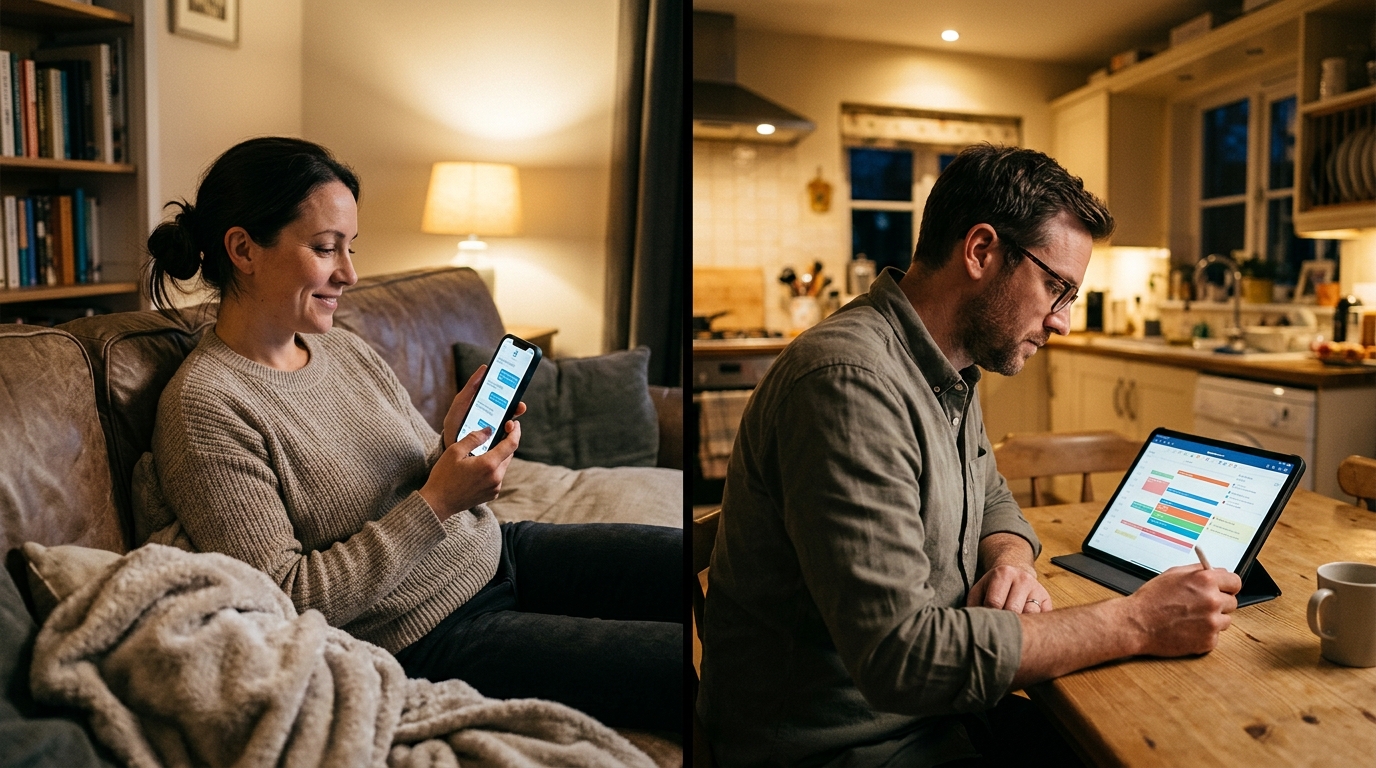
A realistic split-scene composition showing different messaging routines on two devices
A realistic split-scene composition showing different messaging routines on two devices.

More data does not automatically create better judgment

There is a counterargument worth taking seriously: as apps improve, users may become too dependent on logs and alerts. I think that concern is valid. Better tracking can still lead to poor interpretation if the user reads every notification as proof of something bigger.

But I do not think the answer is to avoid the category. I think the answer is to use better tools and better habits. A mature app should help users move from compulsive checking toward calmer review. That is one reason I prefer products that emphasize summaries, history, and repeatable trends instead of nonstop interruption.

In practical terms, a useful last seen record should answer questions like these:

  • Is this activity pattern new, or has it been consistent for weeks?
  • Does the timing align with ordinary routines?
  • Are there repeated online windows that matter more than isolated events?
  • Am I looking for understanding, or am I just refreshing out of habit?

Those questions sound simple, but they separate useful tracking from compulsive monitoring.

Users are learning to ignore superficial alternatives

Category growth always attracts shortcuts. People search for modified messaging tools, unofficial workarounds, or risky alternatives such as GB WhatsApp because they assume “more access” means better insight. In telecom, I have seen this mindset around unofficial routing tools and patched communication apps for years. It usually ends the same way: unstable behavior, unreliable information, or unnecessary privacy risk.

The market is becoming more selective partly because users are getting burned by these shortcuts. They start realizing that unofficial modifications are not the same as a proper analysis tool. The goal is not to force extra visibility into a messaging app. The goal is to interpret observable activity in a stable, practical way.

That is a meaningful distinction, and I expect it to define the next phase of this category.

Simple questions now shape smarter app choices

When people ask me how to evaluate this category, I usually suggest starting with a few plain questions rather than a comparison sheet.

Do I need instant alerts, or do I mainly need a reliable history?
If history matters more, choose an app that helps you review patterns instead of just pushing notifications.

Am I tracking one account casually, or watching ongoing family routines?
For household use, the app should be easy to interpret even when checked by someone who is not technical.

Do I only care about one platform?
If the real-life behavior moves between WhatsApp and Telegram, single-platform visibility may create false conclusions.

Will I still find this useful after the first week?
A good app keeps making sense after the curiosity phase wears off.

That last point is underrated. Many downloads in this space are driven by urgency. The better products survive the moment of urgency and still provide value later.

The category is moving from curiosity to routine utility

That, to me, is the biggest trend of all. This is becoming less of a novelty category and more of a routine utility category. Users are less interested in random glimpses and more interested in structured understanding. They want fewer assumptions, fewer workarounds, and fewer hours spent staring at screens.

As the team behind Mona’s broader app ecosystem at Dynapps LTD continues building communication-focused tools, this shift makes sense. Messaging behavior is now part of how families interpret daily routines, availability, and digital habits. Tools around that behavior are naturally becoming more specialized.

Another article on this blog discusses what 50,000 early users taught the team about WhatsApp and Telegram last seen tracking. That matches what I have observed as well: once people use these tools for a while, they stop wanting more noise and start wanting better interpretation.

If you want one practical takeaway from the current market, it is this: choose a tool that helps you understand recurring behavior, not one that keeps you emotionally hooked to every status change. That is where this category is heading, and frankly, that is where it becomes genuinely useful.

Language
English en العربية ar Dansk da Deutsch de Español es Français fr עברית he हिन्दी hi Magyar hu Bahasa id Italiano it 日本語 ja 한국어 ko Nederlands nl Polski pl Português pt Русский ru Svenska sv Türkçe tr 简体中文 zh